
Key word: safety, security and inclusion
Main characteristics:
Background
Project A – Breaking the Car Habit
Reykjavík is known for its strong “car culture.” Most residents rely on cars for daily travel, often driving alone rather than carpooling. Public transport use has long carried a stigma, and walking or cycling is often dismissed as impractical. Weather is commonly cited as the main barrier, but habits play an even greater role. Once driving becomes the default, alternatives are rarely considered—even on good-weather days.
Challenge: Make the choice of transport conscious again, rather than habitual.
Project B – Transforming Hlemmur Square
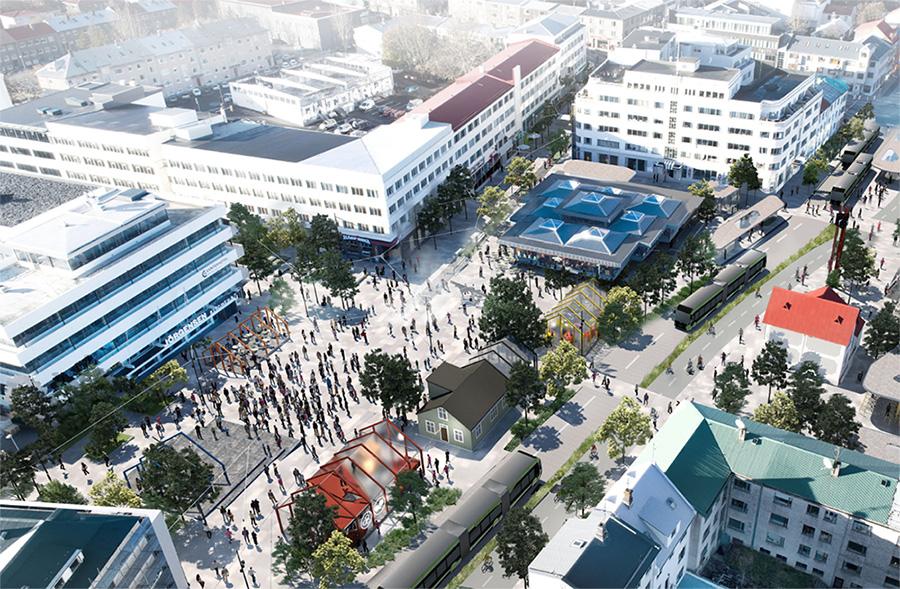
Hlemmur has historically been Reykjavík’s central bus hub, dominated by car traffic and uninviting for pedestrians and cyclists. From 2022-2027, the square is undergoing a major transformation into a car-free mobility hub, prioritizing walking and cycling. During this long construction period, however, accessibility and safety remain pressing concerns, as many people still pass through the site daily.
Challenge: Ensure that green travel remains safe, accessible, and appealing during years of construction.
Project A – Goals and Approach
The aim is to increase the use of green transport modes – walking, cycling, and public transport – among students and employees.
How it works:
A one-month initiative where participants track their transport modes through an app.
- Prizes are awarded to encourage participation:
- Students: The more minutes they travel green, the higher their chance of winning small and large prizes.
- Employees: Prize chances increase if they use green transport at least 3 days per week.
Additional motivators include app notifications, inter-workplace competitions, and behavioral nudges (e.g., implementation intentions).
Long-term vision:
- Encourage participants to make their choice of transport mode conscious rather than habitual.
- Establish the initiative as an annual project at universities and workplaces.
- Share results and expand the model to more schools and organizations.
Project B – Goals and Approach
The focus is on making long-term construction sites in Reykjavík safer and more accessible, with Hlemmur Square as a central case study.
Key actions:
- Before-and-after study: Compare how people move through Hlemmur before (car-heavy road) and after (pedestrian-friendly square) construction (parts of the mobility hub are already constructed, and these parts will be studied).
- On-site interventions to improve safety and accessibility in construction site:
- Reduce falling hazard of concrete block fences by anchoring colorful steel pipes in them that both eliminate tripping risks and guide pedestrians safely through the site.
- Add playful elements (balls on pipes) for children.
- Install benches anchored in the same blocks, signaling safety and providing rest areas.
- Mobility Observation Boxes (MOB): Monitor how these interventions impact flow, accessibility, and risk.
Long-term vision:
- Set a model for improving safety and usability at other construction sites across Reykjavík.
- Demonstrate how inclusive design can make construction zones safer for vulnerable groups, such as children and the visually impaired.
GET IN TOUCH: hannah.ros.sigurdardottir.tobin@reykjavik.is
